


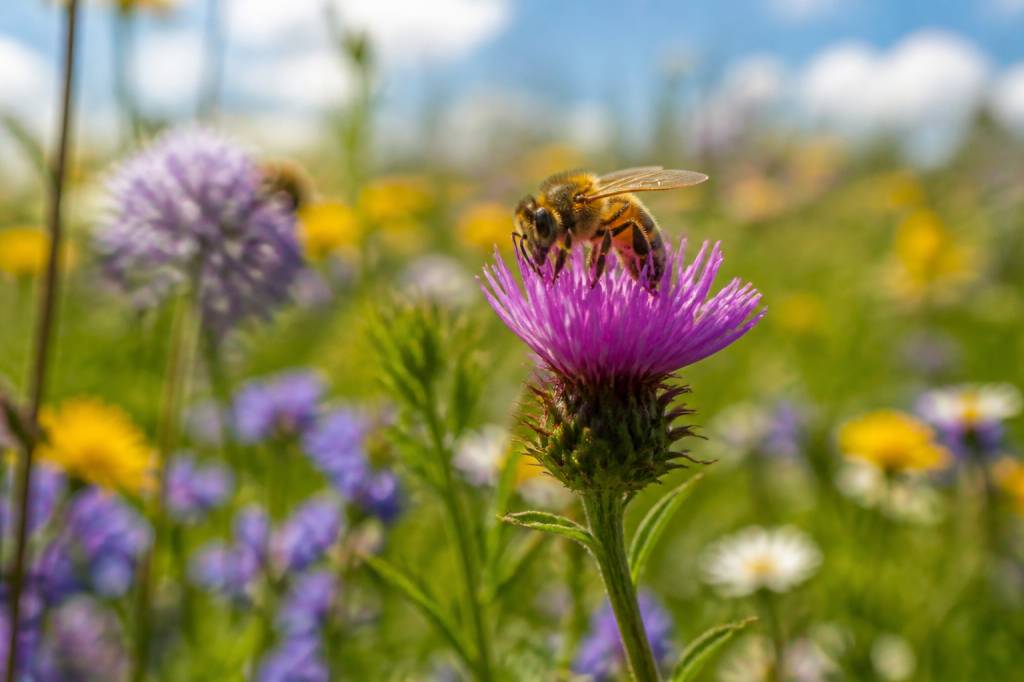
Why bees are far more than “nice to have”
It’s easy to think of bees as tiny background characters in the grand drama of nature: fuzzy, industrious, and vaguely annoying if one happens to land too close to your picnic. But that undersells them in a major way. Bees are among the most important pollinators on the planet, and without them, the ecosystems we rely on would become thinner, weaker, and far less resilient.
Pollination is one of those invisible systems that keeps life moving. A bee visits a flower to collect nectar and pollen, then carries pollen to the next bloom. That exchange allows many plants to reproduce. No pollination, no seeds. No seeds, no fruits. No fruits, no healthy food webs. It’s not dramatic to say that a huge part of terrestrial life is built on this tiny act of transfer.
I still remember hiking through a wildflower meadow in southern Spain, the kind of place where the air seems almost to vibrate with insect life. The flowers looked beautiful, sure, but what struck me was how busy everything was. Bees weren’t just visiting flowers; they were knitting the whole landscape together. That’s the part we often miss. Pollinators are not accessories to nature. They are part of the operating system.
How pollination supports sustainable ecosystems
Sustainable ecosystems depend on diversity, balance, and regeneration. Pollination sits at the centre of all three. Bees help plants reproduce, and those plants provide food and shelter for birds, mammals, insects, and soil organisms. When pollination is healthy, plant communities are more diverse. When plant communities are diverse, ecosystems are better able to handle drought, disease, invasive species, and climate stress.
This matters because ecosystems are not static. They are constantly adjusting. A meadow after a storm, a woodland recovering from a dry summer, a coastal habitat dealing with salt and wind—all of these places rely on living networks that can adapt. Bees help maintain those networks by enabling flowering plants to keep regenerating year after year.
Think of it this way: if ecosystems were cities, bees would not be the traffic lights. They’d be the delivery vans, the courier service, and the small but essential links between neighbourhoods. Without them, the whole place becomes less efficient, less connected, and much more fragile.
What bees actually pollinate
People often assume bees are mainly about honey. Honey is great, but it’s a side benefit, not the main event. Bees pollinate a vast range of plants, including many that support entire habitats and much of our food supply.
Some examples include:
- Wildflowers that support insects, birds, and small mammals
- Fruit crops such as apples, cherries, blueberries, and strawberries
- Oil-producing plants like rapeseed
- Legumes that enrich soil and feed livestock
- Herbs and seed-bearing plants that strengthen mixed ecosystems
In the wild, bees help maintain flowering plants that create cover, stabilise soil, and feed pollinator-dependent species. In agricultural landscapes, they boost yields and improve crop quality. In other words, their work benefits both nature and people, which is one reason the bee conversation should never be treated as a niche environmental issue.
Why bee diversity matters as much as bee numbers
When people talk about bees, they usually picture honeybees. Fair enough—they’re familiar, social, and visible. But honeybees are only one part of a much bigger story. The UK alone is home to hundreds of bee species, including bumblebees, solitary bees, mining bees, leafcutter bees, and many others. Each has its own role, preferred plants, and seasonal rhythm.
This diversity matters because different bees pollinate different plants under different conditions. Some work well in cool weather, some in warm weather. Some buzz-pollinate certain flowers, others specialise in narrow plant groups. If you lose bee diversity, you lose resilience. It’s like relying on one tool for every job and hoping it never breaks.
There’s also a practical truth here: a healthy ecosystem needs redundancy. If one species declines, another may partially fill the gap. But when the whole pollinator community is weakened, the system stops bouncing back so easily. That’s when small changes become big problems.
What is threatening bees right now?
Bees are under pressure from several directions at once, and that’s what makes the issue so serious. It’s rarely one single villain. More often, it’s a stack of stressors that chip away at their survival.
- Habitat loss from development and intensive agriculture
- Reduced floral diversity in farmland and urban areas
- Pesticides, especially when used broadly or repeatedly
- Climate change, which disrupts flowering times and habitats
- Diseases and parasites, particularly where bee populations are stressed
Here’s the uncomfortable bit: many landscapes have become tidy in exactly the wrong way. Short grass, clipped hedges, sterile borders, endless monocultures. Great for appearances, poor for pollinators. Nature doesn’t need perfection. It needs messy continuity—flowers through the seasons, nesting sites, and corridors that let insects move safely across space.
Climate change adds another layer. If flowers bloom earlier because of warming temperatures, but bees emerge later, the timing breaks down. That mismatch may seem small, but ecosystems are built on timing. Miss the window, and the relationship falters.
Why pollinators matter for food security
Bees aren’t just about wildflowers and scenic meadows. They are deeply tied to food production. Around the world, many crops depend on animal pollination to some degree. Without pollinators, farmers may see lower yields, poorer quality produce, and less reliable harvests.
That has real consequences. For consumers, it can mean less variety and higher prices. For farmers, it can mean greater risk and more dependence on managed pollination systems. For ecosystems, it can mean increased pressure to convert more land into production, which can trigger a damaging cycle of habitat loss.
Food security and ecological health are not separate conversations. If you weaken the pollinators, you weaken the whole support structure beneath the food system. Sustainable ecosystems and sustainable agriculture are partners, whether policymakers want to admit it or not.
Urban spaces can help more than you think
One of the more encouraging things I’ve seen in recent years is the rise of pollinator-friendly thinking in cities. Rooftops, roadside verges, community gardens, balconies, parks, and even roundabouts can all become useful habitat if they’re managed with pollinators in mind. Cities are not dead zones for biodiversity. They’re patchwork landscapes, and those patches can connect.
A bee doesn’t care whether a flower sits in a wild meadow or a front garden. It cares whether the flower offers nectar, pollen, and a chance to keep going. Urban areas can provide long flowering seasons, reduced pesticide use in some locations, and warmer microclimates that help certain species thrive.
That said, token gestures are not enough. One lonely lavender plant outside a corporate office won’t save the bees. But large-scale changes—native planting, reduced mowing, green roofs, and pesticide reduction—can make a measurable difference. Small interventions matter most when they are repeated across many spaces.
What makes a bee-friendly landscape?
If you want to support bees, think beyond a single flower bed. A bee-friendly landscape has food, shelter, water, and continuity across the seasons.
- Plant native and pollinator-rich species with staggered flowering times
- Leave some areas uncut so wildflowers can bloom
- Reduce or eliminate pesticide use where possible
- Provide nesting habitats such as bare soil, dead wood, or bee hotels
- Include a shallow water source with stones or landing spots
- Use hedges, meadows, and flowering shrubs to connect habitats
The key is not to create a “bee garden” that peaks in June and goes silent by August. Bees need support across spring, summer, and into autumn. A single season of abundance is helpful. A year-round food chain is better.
Organic farming and regenerative practices can make a difference
Bee health is closely tied to farming practices. Intensive methods that rely on large monocultures and heavy chemical inputs tend to simplify landscapes and reduce food sources for pollinators. By contrast, regenerative and organic approaches can improve conditions by building soil health, increasing plant diversity, and reducing chemical exposure.
That doesn’t mean every organic farm is automatically perfect for bees, or that every conventional farm is a disaster. Real life is more complicated than that. But the direction matters. Practices like cover cropping, hedgerow planting, rotational grazing, mixed cropping, and reduced pesticide reliance can all help create more hospitable landscapes for pollinators.
And here’s the broader point: bee-friendly farming is often good farming. It supports resilient soils, better water retention, and more stable ecosystems. In a world dealing with climate volatility, resilience is not a luxury. It’s survival strategy.
Technology can help, but it can’t replace habitat
At Ethical Projects, it’s hard not to notice the appeal of green technology. Monitoring systems, precision agriculture, biodiversity mapping, and habitat-tracking tools can all help us understand where pollinators are struggling and where action is working. Smart tech can reduce unnecessary spraying, improve land management, and support more targeted conservation.
But technology should never become an excuse for doing less on the ground. A sensor does not replace a hedge. An app does not replace a meadow. Data is useful, but bees need real flowers, real shelter, and real continuity. The best approach is not “tech instead of nature”; it’s tech in service of nature.
That combination is powerful. When land managers know which plants bloom when, how bees move through a landscape, and where gaps exist, they can make smarter decisions. The trick is to keep the ecological basics front and centre.
What you can do without becoming a full-time bee evangelist
You do not need to buy a beekeeping suit or turn your backyard into a laboratory. Supporting pollinators can be simple, practical, and surprisingly effective.
- Choose native flowering plants for gardens and balconies
- Let parts of lawns grow longer
- Avoid spraying pesticides on flowers
- Support farms and brands that value biodiversity
- Join local conservation or planting projects
- Encourage schools, employers, and councils to create pollinator habitats
Even your shopping choices matter more than people like to admit. Food, flowers, and landscaping products all send signals through the supply chain. If enough consumers ask for biodiversity-friendly options, businesses notice. Not instantly. Not magically. But eventually. Markets listen when people keep making the same request with their wallets.
Why this is really about the kind of world we want
Bee conservation is not only about insects. It’s about whether we want living landscapes or stripped-down ones. It’s about whether we accept ecological short-termism as normal. It’s about the future of food, the survival of wild species, and the health of the places we inhabit.
I’ve spent enough time in remote places to know that nature doesn’t need our admiration nearly as much as it needs our restraint. Bees are a good reminder of that. They do their job quietly, efficiently, and without asking for applause. The least we can do is stop making their work harder.
If we design our farms, gardens, cities, and policies with pollinators in mind, we don’t just help bees. We help the ecosystems that hold us up. And frankly, in a world full of overcomplicated solutions, that feels refreshingly straightforward.